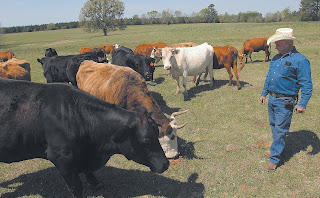
Tidy rows of pine trees grow where cattle once grazed through the rolling hills of East Texas.
Housing developments and lignite mines have swallowed prime pasture land.
Around Longview, cows and calves are dotting fewer landscapes, and local ranchers blame rising costs, fluctuating markets and changing lifestyles for pushing people from cattle production, a rural business with long ties to East Texas.
“The older generation is passing on, and the younger ones don’t pick it up,” said Byron Ford, a Hallsville rancher who runs the Longview Livestock Commission sale barn. “There’s not a lot of money in it, and it’s hard work.”
The number of cattle in the area has fallen by nearly half in the past three decades, but it’s hard to tell that on a Thursday in Longview. That’s when the livestock commission holds its weekly auction, where men in denim shirts and wide-brimmed hats still gather around the cafe at the sale barn just as they always have.
They chew on chicken-fried steak and shoot the breeze. Later, they’ll wander the catwalk high above the holding pens, inspecting the week’s offering. There will be breeding bulls, horses and goats, as well as heifers destined for somebody’s pasture and yearlings and worn-out mama cows destined for the feed lots and slaughter houses out west.
Among the onlookers will be only a handful of serious buyers. Though several East Texans still run large operations, many say they hold onto a few head of cattle as a hobby or for nostalgia. They’re just happy to break even on the endeavor.
“Most of our clients will be people with smaller herds. They’ve been in it forever and were raised in it,” Ford said. “It gets in you. People do it because they’ve always done it.”
Longview’s sale barn was built in the 1960s. There are other sale barns operating around East Texas, including ones in Carthage and Henderson. Ford expects that sales have slowed at all of the East Texas auction houses, and he said he wouldn’t be surprised if some begin to close in the years to come.
“If our numbers don’t pick up, everybody can’t stay in it,” he said.
A small-timer’s habit
These days, most small-time ranchers hold other jobs to pay the bills.
Among them is Danny Jordan, who retired from the U.S. Department of Agriculture after 36 years and now runs a small herd and hauls cattle for a rural sale barn on the weekends.
“Back when I was a kid, back in the ’50s, that was when East Texas was fencing up, and my granddad had a few old cows. It wasn’t nothing because everybody had a few head of cattle,” he said. “Now it has evolved over the years that we have either got some big operators or we’ve got a lot of small operators like me that have a town job to support their habit.”
In the early part of the 20th century, Jordan said, many rural East Texans grew crops for their livelihood. Following World War II, they converted to cattle production. They didn’t have massive spreads like those found in cattle-producing areas of South and West Texas.
“The problem over here in East Texas is everybody’s got 80 acres of land,” he said. “We don’t have any real big landowners. As the cattle industry evolved over the years to better types of cattle, better breeding and better feeding, we had to expand or go out, and there was just so many people here, and I’m exactly what they are.
“Everybody had 75 to 100 acres, and it wasn’t enough to run cattle full time,” he said. “There wasn’t enough money there so they had to go to town and get a job.”
Jordan runs around 60 head of cattle on 92 acres in Laneville.
“I’m so small-time it’s ridiculous, but that’s what I want to do,” he said. “I don’t want to go fishing.”
Fewer cattle, more people?
The USDA figures that show a declining cattle population in East Texas might not tell the complete story, according to Greg Clary, an economist at the Texas AgriLife Research and Extension Center in Overton.
“There may be less cattle, but that doesn’t mean there are less people involved,” he said. “We have so many small herds in East Texas and across the South, there’s just a lot of people that have some cows.”
Clary is among several Texas A&M experts who are leading a “grazing school” this week at the Overton facility, in which greenhorns learn about forage management, genetics and other basics of livestock production. Clary, who is also chairman of the Texas Center for Rural Entrepreneurship, said some small producers still make money from their cattle.
“The possibility is there,” he said. “There are more people that are not making money than are, but there are some that do make money. But you have to really pay attention to all the management aspects of it and keep track of what’s going on from a production standpoint and a cost standpoint.”
Back at the sale barn
Before Thursday’s auction began in Longview, a long line of trucks waited to unload their livestock for the noon sale. Around 600 head of cattle were expected to pass through the auction gates that day, and Art Dudley was next in line to drop off a dozen head.
Dudley, a full-time cattle producer in the Henderson area, said he was just doing what he has always done.
“It’s what I like,” he said. “I don’t want to work for anybody else.”

5,814 responses to “Cattle ranchers dwindling in East Texas”
Hi to every one, it’s truly a nice for me to pay a quick visit this web page, it consists of important Information.|
What’s Going down i’m new to this, I stumbled upon this I’ve found It positively useful and it has aided me out loads. I’m hoping to contribute & aid different users like its helped me. Great job.|
Hi there, I enjoy reading through your article post. I like to write a little comment to support you.|
It’s going to be finish of mine day, except before ending I am reading this enormous piece of writing to increase my experience.|
There is perceptibly a lot to identify about this. I assume you made certain good points in features also.
Somebody necessarily lend a hand to make critically articles I might state. That is the first time I frequented your web page and to this point? I surprised with the research you made to make this actual post amazing. Magnificent process!|
I’m impressed, I have to admit. Seldom do I come across a blog that’s both educative and engaging, and let me tell you, you’ve hit the nail on the head. The issue is something that too few men and women are speaking intelligently about. Now i’m very happy I stumbled across this during my search for something regarding this.|
Have you ever considered publishing an e-book or guest authoring on other websites? I have a blog based upon on the same subjects you discuss and would really like to have you share some stories/information. I know my audience would value your work. If you’re even remotely interested, feel free to shoot me an email.|
It’s a shame you don’t have a donate button! I’d certainly donate to this excellent blog! I guess for now i’ll settle for book-marking and adding your RSS feed to my Google account. I look forward to new updates and will share this blog with my Facebook group. Chat soon!
My developer is trying to convince me to move to .net from PHP. I have always disliked the idea because of the expenses. But he’s tryiong none the less. I’ve been using Movable-type on a number of websites for about a year and am anxious about switching to another platform. I have heard very good things about blogengine.net. Is there a way I can transfer all my wordpress content into it? Any kind of help would be greatly appreciated!
This is a good tip especially to those fresh to the blogosphere. Brief but very precise info… Thanks for sharing this one. A must read post!|
Hello! This post couldn’t be written any better! Reading this post reminds me of my old room mate! He always kept talking about this. I will forward this post to him. Pretty sure he will have a good read. Many thanks for sharing!
Spot on with this write-up, I actually suppose this web site wants way more consideration. I’ll most likely be again to learn much more, thanks for that info.
Great beat ! I would like to apprentice while you amend your site, how could i subscribe for a blog web site? The account aided me a acceptable deal. I had been a little bit acquainted of this your broadcast provided bright clear concept|